Sunday, 12 May 2013

Last Stop - St. Petersburg

Ladies and gentleman, it's been nearly 10 months since the last time I set foot in Canada. Since then I've visited many cities and been to many attractions. You have followed me along my course, become jaded with me, maybe even became bored of the same old pictures of architecture and cityscapes that I became bored of in person.
Church of Our Savior stands down one of the canals
As glamorous as it is to travel, it all becomes too much at some point. And yet you just can't stop while you're ahead. This is the problem I faced upon visiting St. Petersburg, the final "tourist" destination of my travels: could I enjoy it without getting bored?

St. Petersburg is rather unique. Founded by Peter the Great just over 300 years ago, it is pretty young by European standards. Yet it flourished and developed, and today is one of the biggest cities in Europe at over 5 million, and a centre of culture and arts. The city is adorned with lovely canals and, as per usual, impressive palaces, cathedrals and monuments.
St. Petersburg - 670 km!
Surprisingly, transportation between Moscow and St. Petersburg is very expensive and with few alternatives. So I resorted to a method I hadn't used in months - hitchhiking. Fortunately, I started early, because after a disastrous first 5 hours, in which 3 cars and 1 bus took me barely 100 km, I was finally saved by a kind man named Dennis, who took me the rest of the 600 km in about 7 hours. Long day!

The day after I arrived, St. Petersburg was alive and the streets were buzzing at a feverish pitch. It was May 9, Victory Day of the Great Patriotic War. Now without descending into a full blown history lesson, you should at least know that this war is probably known to you as World War II. However, ex-Soviet countries call it the Great Patriotic War, and it only encompasses Russian involvement. Thus, the start of GPW was the day Germany invaded Russia in 1941, and the final date was when Russia captured Berlin on May 9, 1945, NOT the day Japan surrendered after the dropping of the atomic bomb.
May 9 - Victory Day Parade

Anyway, May 9 was a good day to be out on the streets in Moscow, St. Petersburg, or any major city in Russia. There was a Victory Parade in the afternoon, then in the evening there were also fireworks, and many of the main streets were closed down so that pedestrians filled the streets, chanting and singing with pride.
Fireworks seen from a packed bridge
Besides the festivities, I managed to see two pretty memorable museums. One local treasure was the miniature museum, which illustrated Russia in one massive papier-mache incredibly detailed landscape brought to life with miniature buildings and people. It even had moving trains and cars, and a real time traffic control system for these mini vehicles, operated by staff behind a window. As an engineer, wow!

The other museum I saw was the Hermitage, the second largest museum in the world. Quite resembling the Louvre, the interior is decorated like the best palaces in Europe, with grand hallways covered with frescoes, statues, gold trim and finely ornamented. The museum's collection houses millions of items, mostly paintings and artifacts of European origin. I braved over 2 hours in the rain lining up for this beast. And, well, it was worth it.
Standing in line for the Hermitage - lady in umbrella says it all
As a jaded tourist, I couldn't be bothered to pay the extra 200 rubles, or about 5 euros, for the right to take photos. Nor could I bother to search out any featured paintings or statues in the massive complex. Thus, I discarded the map and wandered aimlessly, like a kid in a neverending candy shop.

In similar fashion, the rest of my time in St. Petersburg was spent walking. I've learned that walking is the best way to get to know a city. That and avoid spending money on attractions that are ultimately forgettable. Curiously, clamoring around St. Petersburg's streets, I felt like Raskolnikoff, the main character in Dostoevsky's thrilling Crime and Punishment, which I am not so coincidentally currently reading.
Neva River, which adds to the beauty of St. Petersburg
Despite all the goodies mentioned above, my time in St. Petersburg was ambivalent. In my jaded state, I probably enjoyed this city more like a bored fool than a wide eyed camera toting tourist. Besides, other external matters played a part in my moodiness, such as bad weather and painful feet.

But what right do I have to complain? None, really. I owe nothing except gratitude for being a tourist for so long. With this in mind, I can rightfully conclude that St. Petersburg is a pretty great city and one highly recommended by myself.

As I write this, I am back in Moscow living out my days as a free man, back in less than 2 weeks. And though I will be glad to come home, a part of me will wish I was still living out of a suitcase, checking famous cities and big museums off my bucket list.

Flickr: http://www.flickr.com/photos/11monthsandrew/sets/72157633476998440/
Contemplative walk along the Neva River, last night of St. Petersburg

Friday, 19 April 2013

Off To Where the Sun Sets on Europe

Check one off the bucket list.

Having seen the majority of mainland Western Europe, I felt reluctantly obligated to see Portugal. Given a lucky window of opportunity, waiting two weeks for my Visa to Russia to process while in Madrid, instead of waiting around, I packed my bags once again and headed west.
Apparently you can buy love in Lisboa
But I did much more than just "knock Portugal off the list." In fact, I had a really great time there!

Portugal gets as little attention as central and eastern Europe but after visiting it I see why it is a rising star of tourism in Europe. Lisboa (Lisbon), the capital city, is a city that has it all, tied up in a neat little package. It has all the traits of a historical European city, castle on a hill overlooking a romantic old city by the water, plus it also offers many modern attractions and provides a good base for day trips to the countryside.
Mirador (lookout) of Lisboa
While I am not a shopper, I love visiting markets to see what the locals have to offer. In Lisboa, I was ready to throw my wallet at everything I saw. The second-hand markets, set up in first rate outdoor spaces in the city, sold absolutely anything and everything the slightest bit useful or desirable, from old plastic toys to film cameras and rusting silverware. If you are looking for new things, there are markets thriving with creative energy for the arts and crafts from jewellery and household decorations down to keychains and postcards. In fact, the Iberian Peninsula which includes Spain showcases the best arts and crafts in Europe. I managed to fish a few dollars out to buy my first magnets of the trip.

From Lisboa, I made a few day trips. My first day trip was to Cascais, a little oceanside town full of villas and yachts, to join a Couchsurfing photowalk event, and to get my first glimpse of the Atlantic Ocean. My second day trip was to picturesque Sintra, complete with a dreamy Disney-like castle on a hill, and a view of the westernmost point of mainland Europe.
Castle at Sintra
I also had some of the best seafood of my trip in a little hideaway restaurant that indicated, through no indications at all, that it was a local joint. Eating here reminded me that I always had the best dining experiences by straying off the main street and finding places that didn't want to be found.

From there it was on to sleepy Lagos on the southern coast of Portugal. A day trip took me to Sagres and slightly beyond, to the southwestern most point of mainland Europe where mighty waves crashed into mightier cliffs.
Checking out the cliffs and beaches in Lagos

Back in Lagos, I went on a kayaking tour along its less mighty yet wonderfully abstract cliffs, its red and white hues of rock curving mysteriously, and unveiling pristine beaches in its bosom. The kayak tour stopped at one of the beaches for a rest. While most people were deterred from the water, still dreadfully cold and slow to warm up, it did not stop a Canadian like me from going for a swim! The irony here is that there were other Canadians on the tour who did not even consider dipping a toe in the water.

On my final day in Lagos, one where the sun shone down soothing warmth and with not a cloud in the sky, I descended into a rocky nook on Batatas Beach all to myself, and did some yoga. My mind cleared... bliss, happiness... and nothing needs more to be said about Lagos!

Flickr Photos: http://www.flickr.com/photos/11monthsandrew/sets/72157633271763021/

Also photos from Sevilla: http://www.flickr.com/photos/11monthsandrew/sets/72157633276142490/
Plaza De Espana, Sevilla

Wednesday, 3 April 2013

Morocco - A Diamond in the Rough

March 21 was a special day. It was my birthday, it was the day I flew into Madrid to join my friends to go to Morocco, and it also marked nearly 8 months of travelling around Europe.

Now, some of you may say, and fairly so, that my travels have been rather safe. Turkey had eastern flair, but it meets the modernity and security of the west, and Moscow, Russia, though distant and seems mysterious and foreign, has a similar infrastructure, familiar to the cold climate cities of Canada.
The Atlas Mountains - welcome to the desert
Morocco was my first venture into a truly untamed land, one that operates with a minimal emphasis on rules. This Diamond in the Rough has an exotic appeal that makes you feel like you are walking in Disney's Aladdin. Morocco felt like a whole new world... its spectrum of unbelievable-ridiculous to miraculous-beautiful stretches as far as the bright white moon rising in the desert.
A desert ghost, revealed only by moonlight 
Here cars share the road with donkeys hauling carts, people are super friendly, and shopkeepers haggle persistently and persuade like CEOs. The streets of the medinas, the old walled city centres, showcase a dazzling array of wares that glitter from greens to reds to yellows. The surprisingly diverse landscape is blanketed with as many impressive colours - more green than you think.
Stand aside when a donkey is coming through! 
Moroccan food is defined by lots of spices, and is headlined by Berber whiskey, couscous and tajines, which consist of cone shaped pottery cooked by fire. We ate a lot of couscous and tajines and, while it was very good, we started getting sick of it after awhile. It should be noted that Berber Whiskey is just mint tea. You can't find any alcohol within the bustling medinas. Anyhow.. let's get to the story!
Chefchaouen, the Blue City
I travelled with my friends Sam & Claire, English teachers in Madrid, who I met at La Tomatina at the end of last August, which now seems like an eternity ago. We took a flight into Tangier and immediately hopped on a taxi to our first destination, Chefchaouen, nicknamed the Blue City. It's no wonder, with its memorable baby blue walls and doors, papier-mached on a backdrop of a lush green valley while chocolate brown mountains loom above.
This girl started playing with my harmonica 
We instantly received the "friendliness" of the people - colourful-hoodie-wearing Berber shopkeepers waving you into their showrooms, restaurateurs telling you that you're hungry, and even people approaching you and, in a low whisper, offering hash, the best of which originates in the local region surrounding Chefchaouen. We preferred the friendliness of local children. Oh, and the cats too, which there are plenty of wandering the narrow pathways.
"If I fitz I sitz" - Cat in the Basket 
Fez was the most intense experience of possibly all my travels. The city of Fez has the largest medina of any Arab city in the world. Thus, tourists are actually recommended to hire guides to navigate in the medina's thousands of narrow, zigzagging streets. Oh, and also not to wander around at night. This is exactly what we decided to do after we arrived in the evening from Chefchaouen.

Once we got off the main street and entered the medina's maze, we got tailed by two different guys, acting friendly at first. However, several minutes later, when we tried to lose them, they turned sour on us. They began saying very mean things and wouldn't leave us alone. We eventually found our way back to the main street where they finally stopped following and hurling insults at us. Nevertheless, we were traumatized, and I had never been in this state of fear and anxiety at any point in my trip.
Wandering Fez with our favourite guide Rashid! 
Fortunately a new brilliant day followed, and the memory of last night was completely wiped out following our meeting with Rashid. Once again, we were befriended by a local but, while I was still wary, Sam had a good instinct about Rashid and so we let him guide us. Rashid turned out to be an amazing guide and good company too.
Claire, Sam and I trying on Moroccan clothing in Coca, Rashid's sister's shop 
We followed Rashid into donkey sheds and leather workshops including the large tannery. He introduced us to his sister Coca (pronounced kooka) who worked at the family clothing shop, and they even let us try on traditional Moroccan clothing, which is really beautiful. During the entire tour Rashid answered questions about Moroccan life. To top it off, he took us to the high point where we could view the medina in all its glory, brown mud-brick buildings waving up and down with the valley floor, standing like a forest among over 9000 little streets.
Donkey overlooking his medina domain 
Next we went for the overnight Sahara desert 2-day 1-night excursion. While we didn't quite make it into the heart of the desert, it still was an amazing experience from start to finish. The 8-hour drive took us through stunning landscapes that slowly transformed from vibrant greens to lifeless brown and gray rock, to sand. We rode camels into the sunset, getting off at our tent campsite in a beige plain surrounded by mini sand dunes, like waves cresting near the beach.
I got ass-burn from riding camels for 2 hours 
Enter Mohamed, one cool cat. His eyes shone of eternal wisdom (even though he didn't look that old) and his personality crackled through his big smile. Mohamed and his fellow Berbers served us a tajine chicken dinner, then entertained us "Justin Berber" style with singing and drums round the fire under a full moon night. Mohamed invited me to stay longer, maybe live like a Berber, nomads still wandering the desert, one earthly vestige that human civilization has yet to tame. I'm not sure whether his invitation was serious, but I would definitely consider it, especially if I could take care of camels, very charming creatures with really funny faces.
Mohamed is the richest man I know, not in materials, but in happiness, peace, and love of his desert home 
Our last stop was Marrakech, and possibly the best city of our visit. It's one of the bigger cities in the nation of up to 40 million people, and has something for everyone. The shopkeepers here were generally very friendly and relaxed, and I talked to many locals with no worries. I took pictures of some of them and even promised to print out their picture and mail it to them, since they probably don't own cameras or have an e-mail address.
A man surveys the street he's worked on as a shop seller for decades 
Marrakech's main square Jemaa El Fna, was a riot - the very heart of Morocco. This open space is never really "open" as its void is constantly streaming with noise and dust kicked up from taxis, scooters and donkeys, weaving their way carelessly around pedestrians and entertainers such as snake charmers and buskers, further cramped in by food stalls, cafe tables and shop wares.
Cheap and tasty eats outside in Jemaa El Fna. Me in my new Berber hoodie 
We all decided to splurge a little on our final stop, so we went souvenir shopping. I decided to emulate my desert hero Mohamed and bought a Berber hoodie, virtually the exact same as his! I still have to figure out how to bring it home with me, since my luggage is out of space.

Goodbye Morocco!
Sunset on Morocco
While I deviated from my ethics of not travelling by plane, flying from Berlin to Madrid to join Sam and Claire, then flying to and back from Morocco was totally worth it. Before this my trip had been missing something, it was too safe and, thus, boring. Morocco gave it that vibrant feeling of life uncorked, the best and the worst surrounding you so that unpredictability shrouds every turn around a street corner, but no matter what happens, it's new, a little scary, and very exciting.

I can go home now and say I saw it all on my travels. (caution: hyperbole)

Flickr Photos: http://www.flickr.com/photos/11monthsandrew/sets/72157633156426750/
Wacky turbans

Wednesday, 20 March 2013

Don't Call Them Eastern Europe

North Americans commonly misuse the term "Eastern Europe" to distinguish from the western European countries that are more ubiquitous with their romantic idea of Europe. Thus, Central Europe gets less attention from would-be travellers infatuated with glorious cultures such as French and Italian. Nevertheless, this region is characterized by a vibrant culture driven by remarkably creative and energetic youth. There is lots to see and do, and all within the confines of a cheap and safe environment.
Vltava River, Praha
The three headed beast of Budapest, Wien and Praha power the engine of Central Europe (well, I'm not actually sure where Central Europe proper is or if there is even an actual defined border for this region). I have a bad habit of calling cities by their local names. So to clarify: Wien, the capital of Austria and home of the wiener, is Vienna. Praha, the capital of Czech Republic, is Prague. Budapest, the capital of Hungary, is actually BudapeÅŸt with a "sh" sound.

Herein is a quick and dirty comparison of my time and impression of each of the cities. I am therefore obligated to give you the standard black-and-white warning message that "the views and opinions expressed here are solely based on my experience and are not stated as facts, nor are they intended to cause offence to the subject parties" and so forth and so forth...

In other words, don't sue me, don't hate me. After all, I'm only writing because you want to read me.

Architecture
Budapest, Wien and Praha are holdovers from the Habsburg Empire of the middle of the second millennium and, thus, share similar architectural styles. Winding streets in the city centres are arranged with colourful buildings of 7 or 8 stories, made of massive interlocking stone blocks that seem to jump out at you. One gets a majestic feeling walking around these cities.

Praha is definitely the prettiest city of the three. In fact, it has maybe the best mix of urban development, topography and green spaces I have seen anywhere in Europe. Its cathedrals stand tall and gothic dark, flanked by buildings with eclectic designs and adornments. Its picturesque river, the Vltava, splits the old city, Staremesto, from the hilly castle side, with grand vistas of the entire city.
Graben pedestrian street, Wien
Wien stuns through sheer grandness and scale. Viewing cathedrals and government buildings require physical exercise - many repetitions of neck craning and jaw dropping. But its open spaces provide the correct viewing angles as they are impressively large and inspire a royal feeling of happy-bliss. At street level, the sidewalks are clean and orderly, a byproduct of German efficiency.

Budapest has a beautiful city centre, characterized by a castle on a hill, overlooking a steady river and an old city. But the city still bears many scars from its communist days. These scars are bandaged within the city centre, but are clearly visible if you enter the suburbs, still blanketed by dull concrete housing. The lack of restoration of the suburbs of Budapest is reflected in Hungary's weak economy.
Duna, or Danube River, Budapest
Culture
Tourists on whirlwind Eurotrips might lump these cities into one category, which is understandable considering their geography, population and cultural similarities such as food. But I think Budapest, Wien and Praha are wonderfully unique. Its the same principle in which people may mistake Calgary and Edmonton for being the same kind of city, or Toronto and Montreal.

Budapest has an unbelievably youthful vibe. It feels as if all the old people decided to move out and let the youth take over. On the streets, in the shops and metros, young people are everywhere, walking with style and a sense of determination, as if they are busy conquering the world. Their spirit and energy has imbued a creative atmosphere that can be seen in its trendy shops and in its trademark nightlife attraction, the ruin bars, which have a rough and edgy feel, and are covered wall-to-wall with eclectic and retro objects.

Wien is the only of the three cities that escaped the Soviet influence of communism and therefore has enjoyed economic prosperity since WWII. Its wealth combined with German efficiency is evident walking around the city. Despite this, Wien has a young and creative energy that has helped to propel it into the rarefied air of one of the most desirable cities in the world to live and work, with one of the highest quality of life ratings. There are many wonderful coffee shops to gather and philosophize, cinemas to enjoy films, and museums to get your think-on.
Charles Bridge, Praha - busker with marionette
Praha is developing a reputation for being the Amsterdam of the east. In Praha, you can party cheap and party hard. I've heard anecdotally that you can get easy access to any drug you desire, and that there is a fairly casual approach to dating. It's easy to see why people party so much here - Czech beers and liquors are some of the best in Europe. Kozel is one of my favourite beers and I believe it is sold internationally. And the Czech national liquor Becherovka is 38% alcohol, but goes down super sweet and smooth.

My Experience
Unfortunately I had to rush through this leg of my journey. I could easily have spent much more time in each of these three cities. As usual, my personal accounts of these cities have nothing to do with the museums and cool buildings, but are defined by the people I met.
First time playing sports in a looong time. I really missed it
In Praha, I had the privilege of staying with someone who could lay claim to being "the most interesting man in the world." This ex-video engineer for the Rolling Stones, ex-army officer, now turned English teacher held a concert on his birthday in which he performed with his rock band. The day after, we participated in indoor beach volleyball, an event which he also organized. My friend could also lay claim to the title of "the messiest man in the world." Though his flat was a sight for sore eyes, it reminded me that his priorities lay in his passions: languages, music and people. I cleaned his dishes for his birthday! I also met up with a friend whom I met a several months earlier, and we had a great chat over our exciting working experiences since our first meeting.
Opera in Wien
In Wien, I stayed with a great Couchsurfing host. He inspired me to find homestays in Buddhist monasteries. Ironically, due to the uninspiring weather, I was able to find some really hip coffee shops to take shelter. Later on, squished in the standing room section of the opera, which is the thing to see in Vienna, I found one of those random encounters which I preached so much about. I made friends with a Latvian English teacher, and afterwards we chatted over McDonald's 1 euro burgers, then the next day over pay-as-you-wish Indian food.
Market in Budapest
Budapest was one of the few cities I visited a second time; also one of the few places I kept meeting really memorable people. I stayed at two different hostels and with two different Couchsurfers, each a fun and positive experience. But I actually did stuff too. By night I frequented ruin bars and, by day, ate at the train station styled market and sauntered up and down the Duna (Danube) River. I even splurged in one of the many secondhand shops. I also went caving, an awesomely fun adventure, and visited the famous hot baths, filled with people of all ages and minimal clothing, to escape the cold weather.

-----

Despite the harsh realities about Budapest, it is a really awesome city. I had an amazing time and will take away some of my best memories of my trip from here. Wien, while it is very posh and proper, especially compared with the casual "no rules" mentality of Praha and Budapest, also has something for everyone. And Praha is simply the place to be to go wild and live life to the max, but also provides enough space for quiet and contemplation.

However this, my dear readers, does not mean I am recommending Budapest to you. One lesson that has continuously repeated itself during my trip is that every place in the world is unique. So I guess what I'm saying is... go to all three!

One end of the Charles Bridge, Praha

Saturday, 2 March 2013

I Stayed For The Cats

Finally, after my whirlwind tour through eastern Europe and Turkey, I was ready for my second working stint, after teaching English in Moscow, and the first farmstay of my travels.
The beautiful Peloponnese in southern Greece
For those not familiar with the concept, a farmstay entails working on a farm for accommodation and food. It has been popularized by the online network WWOOF.org – World Wide Opportunities for Organic Farming, which connects farmers to eager helpers. “WWOOFing” is actually quite popular for many reasons. For myself, it allows a born and raised urbanite with zero relationship with earth and the fields which produce what goes on my fork, to get some real hands-on experience with farming, and witness first-hand the 100% natural and chemical-free circle of life. And enjoy its spoils, such as real olive oil, that which cannot be obtained in Canada.

My latest opportunity took me to Elea, in the rolling gray mountains of the Peloponnese, near the southern tip of Greece. This farmstay, like my teaching stint, was available on helpx.net, which connects helpers to help exchanges beyond just organic farming. However, I was initially recommended it by my friend Chris who met me in Istanbul after his farmstay here. The welcoming and warm family, Roberto, Barbara and their daughter Lorena are helpX veterans, having hosted many helpers in the past. I joined them and another helper, Leslie from France.
Non-stop olive picking for about 2 weeks
My main job was to help pick olives in a large orchard, rows upon rows of olive trees, as part of a five-person crew. The task involved a lot of cutting branches with saws, and ripping olives off of those branches with oversized mechanical toothbrushes. Although the physical labour was tiring at times, I was able to work at my own pace and the hours were never excessive. And here's the kicker - I got to be outdoors all day, surrounded by trees, mountains and sky, and not cubicle walls, prison-like in their oppression.

In fact, there was nothing oppressing about this life.
A cloudless morning for clear mountain viewing
For over two weeks I woke up to an amazing view of the Mediterranean Sea, surrounded by flat blue-gray mountains with white icing on top. Cats and dogs greeted me on the front porch. Also on the farm were horses, goats, chickens and rabbits. A natural soundtrack accompanied the morning show, played by roosters and songbirds, with no car engines to drown them out. It is a place that reminds you that, quoting the movie Water World, if you sit still, you can hear the sound of the world. It was a truly ideal natural escape. Cars weren’t the only modern amenity absent. With wood powered stoves for indoor heating and solar powered water heating, I had to adapt to a little less comfort in the home.

However, my connection to the innocent and entirely natural setting of the farm could have been severed by the presence of another overpowering technological connection  - the internet. Thankfully, the family once had it but was now rid of it, due to conflicts with their provider. Without it I was unshackled from the worst of soul-sucking distractions, and free to enjoy what was directly in front of me – blissful nature.
One half of the cats on the farm on a windowsill
Aside from working I did a lot of reading, some yoga, and hung out with the animals, particularly the cats. The family took us on some day trips to historic ruin sites in the Peloponnese. Oh, and they kept me very well fed! They cooked lots, I even cooked some. Best of all, everything was organic, and most of it was from our own backyard. Oranges and almonds may taste good anywhere, but there’s an added authenticity about picking it fresh off the tree.

I could really go on and on about what I learned and did in two weeks… alas, there is only time for the moral of my story…
Day trip to Monemvasia, with stunning views of Greece
Roberto and Barbara’s farm provided the perfect tonic for my travels, a much needed change of pace, and a foray into organic farming, developing a stronger connection with the earth. The main header of my Calgary blog says “finding tranquility.” I found lots of it here, however, like enlightenment and other perfect things, pure tranquility is hard to find. In my search I ventured from one side of the lifestyle balance to the other – urbanite to ruralite. But I gained an appreciation and a realization that I still crave certain aspects of urban life. Now my challenge is to strike a meaningful balance of both.

If you have always wondered where your food comes from beyond the freezers and aisles in your local supermarket, sought an escape from urban life or, conversely, a stronger connection with animals and the earth (or simply need a free place to stay and are willing to work), I highly suggest doing a farmstay (even purebred urbanophiles will benefit, I think, gaining an appreciation for the concrete and steel habitats in which they are adapted).

Farmstays are available all over the world, some are probably even a short drive from your home, and vary in stay lengths, from weeks to just a weekent. The recommended websites WWOOF, helpX and Workaway are not free, but do not cost much to use, especially compared to the money saved doing a farmstay. It’s an enriching and potentially life changing experience. I definitely recommend it!

A valley of olives and oranges
Flickr photos: http://www.flickr.com/photos/11monthsandrew/sets/72157632892487223/
Cats are king
Cat album: http://www.flickr.com/photos/11monthsandrew/sets/72157632896898230/

Friday, 22 February 2013

Chance Encounters and Random Conversations


I want to regurgitate to you an insightful conversation I had with a friend regarding, ironically, conversations. Let’s call him Joe.

Joe referred to a speech he heard describing Canadian homes as being like vaults or safes. “It’s not easy for people to invite others into their homes or open it up to strangers,” he said in more or less those words. Inviting people into your home is a powerful thing – it abandons pretenses and prejudices, evokes openness and ingenuity. But, he points out, “mostly, we meet at coffee shops or bars instead of having chance encounters and random conversations…”
A random encounter in Brussels led to dinner with Ata, a lovely and wise old man - twice! 
Conversations are human’s biological tool to communicate with the world around us. They enable us to exchange information critical to our daily survival. They also enrich our lives by allowing us to share laughs and smiles and build friendships. Conversations allow us, quite simply, to connect with other people. However, conversation is becoming a lost art. And here’s why: in today’s fast paced society we, as individuals, try to make sense of the chaos in our lives by exerting too much control over our time.

Every time block of our lives is becoming compartmentalized for specific tasks. As a result, we have become slaves to our own agendas. Every week, day and even hour is mentally predestined. We are either living in the future or dwelling on the past. During scheduled appointments half our minds are already on the next appointment. We hurry from place to place not even factoring in time for traffic delays, as if expecting the vehicles on the street to magically part like the Red Sea for Moses.

The time stress we induce on our own psyches is phenomenal. Yet today it’s become a sort of badge of honour to be busy. Recognition is heaped upon productivity superstars, reputation bestowed upon ultra-performers, with jealous competitors not far behind, taking on more aggressive schedules to get ahead. Sacrificed, in the name of efficiency overdrive is quality and integrity, fostered only with patience and care. With less time, everything we do is more prone to mistakes. With less time, we put on a superficial mask in front of everyone we meet.

With less time there is less opportunity for, you guessed it, chance encounters and random conversations. No time for a bump and a chat with a friend on the street. Time to help somebody who is lost find their way. Time to invite people into our homes. No, there is only time to share a quick drink at a coffee shop before our next task beckons.

Sometimes not even that. Joe told me how frustrated he became when we were having trouble meeting up before I left on my trip because he was too busy. “I did not have the flexibility to change my schedule to have that spontaneity… we try to force randomness in our schedule rather than providing randomness the opportunity to find us.”
Free hugs event in London - random encounters at its awkwardest! 
Individuals in our rushed culture are compartmentalizing more than just their time. Private vehicles are isolating commuters from interacting with strangers on the sidewalk or on buses or subways. Our homes, like broken ice sheets in the Antarctic, are drifting further apart, isolating us from our neighbours. The homes themselves are becoming larger and filled with more and more valuable possessions, further ensuring that we will never trust strangers in our home. Not so in other cultures such as India, where people live in smaller and denser tight-knit communities, have fewer possessions in their homes but are very warm and welcoming.

Planning out our lives, whether it’s the next 5 years or 5 minutes, gives us some stability amidst unpredictability, but we lose the magic of the moment. Nowhere have I learned this lesson more than in long-term travelling. Abandoning nearly all my possessions, concrete plans and time constraints, I find myself open to chance encounters and meetings. Each meeting brings with it the potential for fun and adventure, and is not considered time wasted or a distraction. Some meetings blossom into stronger connections. But at the very least I get a smile, an assurance that I made someone's day better.

I told my friend that “back home we are all about individuality. We each have ambitions and needs which don’t really fit into harmony with other people’s lives, and so we exclude them. Travelling forces us to intertwine our fates with others.” But even most of us travel on prepackaged vacations designed for maximum privacy with a nice beachfront view.
Budapest host - Couchsurfing means opening up your home - whether it's 1 or 6 people! 
So try something different for once. Clear your schedule for the following week as much as possible. When that week arrives, you may find yourself more relaxed, clear of mind, even a little excited about the endless possibilities of a week with no obligations. Anything can happen. Randomness is invited. Don't worry, it may feel a little strange at first to have nothing to do or worry about, but you'll grow into it.

I would like to conclude with some excerpts from Joe's closing rant: “when you’re not busy it is easy to feel alone because everyone is busy so you feel the need to compete… but if you don’t have the time just to have the opportunity for randomness and for keeping your doors open… how are we supposed to connect with people beyond a superficial level?”

Saturday, 9 February 2013

Getting Stuffed in Turkey


In the past few months, you have witnessed my slow transformation, shedding my identity as tourist for something more abstract, bordering on soul searcher. Having just arrived in Greece to start work on a farm, my transformation became complete. But not before climaxing in Turkey on a wild flourish of touristic attractions.

Thus, I present to you what may be the last touristy blog I will write. Warning - could cause you to stop everything and go to Turkey.

-----------

Turkey arguably has the richest history of any country in the past 2000 years. But take a wander 'round and you'll discover that it has a lot more to offer than just museums and mosques.
Inside the Aya Sophia - most gorgeous mosque in Istanbul
During this time period, Constantinople perched itself on top of the world, overseeing the dominant Roman, Byzantine and Ottoman Empires, accumulating mass riches and a wealth of architecture. It became Istanbul after the fall of the Ottoman Empire after WWI. I felt the history as I first stepped foot in the main square of Istanbul's historic neighbourhood Sultanahmet, centred by a large fountain and framed on both sides by the glorious Aya Sophia and Blue Mosque. There is so much to offer in Istanbul that I ended up staying 10 days to do everything imaginable, but mainly to enjoy it all in the company of good people. I went out in modern Taksim, stayed in, walked around, visited mosques, saw museums, fit in a boat tour and a day trip to a WWI site, and even sat in on a presentation about Islam.
Istanbul Archaeological Museum - Sean measuring himself up to a column capital from Temple of Artemis 
But my favourite experience was probably the Turkish bath, or Hamam. It sounds strange to say this, but the man who bathed and massaged me during the experience was very rough with me, yanking me around like rag doll – and I liked it. But what I definitely did not like was the pot-bellied Turkish man stalking me around the baths after my treatment, following me from the cool down pool to sauna, then to steam room, then the bath area, sitting literally a metre from me each time. Thankfully, he never got any closer.

Finally, when I strayed outside of the bustling metropolis I found an even more diverse and dazzling array of natural phenomena. I traded in my thinking cap for an Indiana Jones hat and Tomb Raider tights and explored Turkey's countryside like a pioneer in a new land.
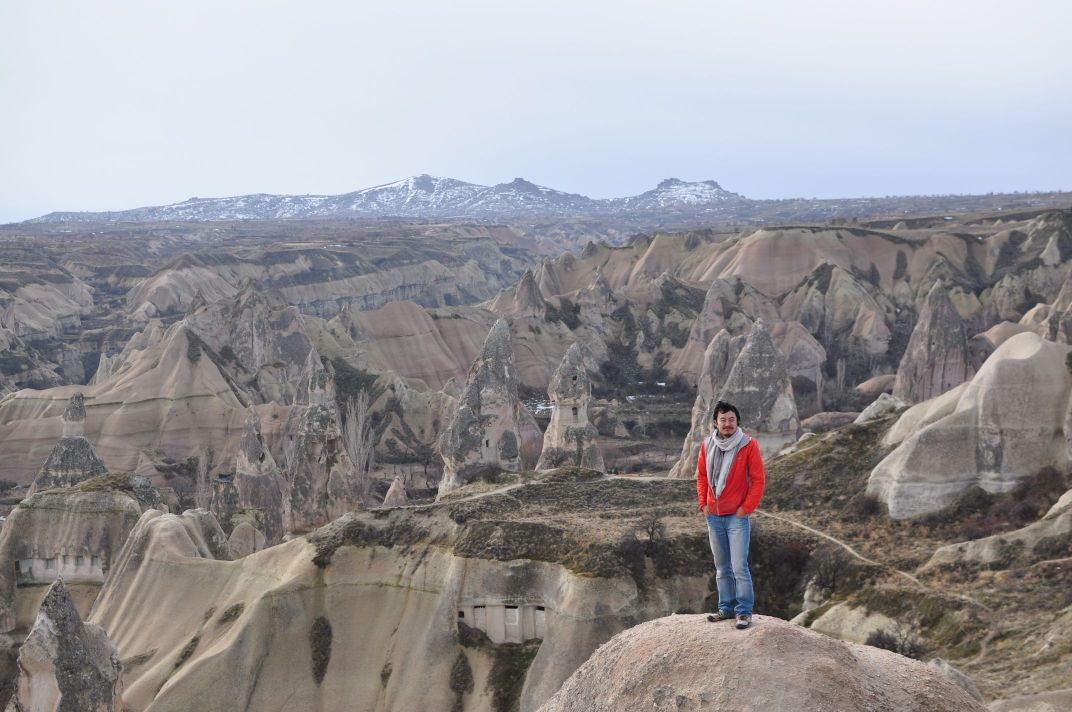
Cappadocia - a place like no place on earth
Cappadocia, with its old and mysterious cave dwellings carved into even older “fairy chimneys” formed by erosion, feels like a land out of a fairy tale. Most travelers I met here took to the skies in a hot air balloon but I felt my experience was equally rewarding keeping both feet on the ground – and 100 euros in my wallet. I hiked tirelessly for two full days, descending valleys and ascending ridges over and over. Each viewpoint was more unbelievable than the next, provoking equally joyful and agonizing primal screams. In my hostel in Cappadocia I met probably the most positive guy on my travels. Michi arrived during breakfast, gave a friendly greeting to my group and indicated with a warm but assertive smile that he was going to sit down with us and become our friend. And that was the truth!
Rose Valley - like waking up in a dream
I settled temporarily back into city life with a couple of days in sunny Antalya. It’s the first Turkish city outside of Istanbul I visited and I really liked its vibe. People were quite helpful. I even played football with some kids in a park and joked around with them for a bit. Also, its placement between the Mediterranean coast and stunning mountains makes it the perfect place to admire a sunset.
"Oh wow, a stranger! Let's talk to him!"
A visit to Termessos ruins near Antalya came really close to topping Cappadocia. In a high mountain valley, navigating stone slabs scattered like sand among crumbled buildings, with hardly anyone else around, I felt like a kid in a playground with no parental supervision. The theatre with its magnificent ring seating overlooking the stage below and mountains above in all directions made you wish you were a spectator of a Roman performance back in the heyday of this abandoned ancient city.
Termessos - a theatre with a view
Next I spent a couple of days in picturesque Olympos, a ruins of a once thriving port city situated near pebble beaches and nestled in thick forested mountains. The area was dotted with numerous restaurants and pensions (a kind of accommodations) which would all be packed in the summer but, again, hardly anyone was around. The highlight was Chimaera, a site where natural gas vents into the atmosphere as fire. I wish I had brought marshmallows or raw kebabs. Back at the hostel, I shared my wooden cabin with two wonderful Americans, who I clicked with right away. We parted just after meditating on the beach.
Chimaera in Olympos -
imagine having a permanent fire in your backyard 
In Pamukkale, fire gave way to water but in a rare and spectacular form – travertine pools. Here calcium deposits achieved epic proportions, taking over the landscape, forming grand white cliffs. Water flows down these cliffs, forming pools, stepping down like classic rice paddies in China. And yes, there were ruins on site too.

Pamukkale - barefoot policy more than just for mosques

My final destination was Selcuk to see the granddaddy of all ruins in Turkey – Ephesus. But not before an unexpected scare. A screwup on my bus ticket took me to the wrong city at night. A smooth talking guy at the bus station convinced me to let him help me. But while he was trying to help, we chatted, and I slowly became aware that this guy had some issues. I learned his name was “Sanchez” which actually sounds Mexican, he works for the Turkish Service Service, and he fought in southeastern Turkey against the Kurdish, resulting in three bullets lodged in his left leg. The whole time he drank in public and even peed several times, waving around his wang in plain sight, and he kept telling me to watch his bag closely and don’t let anyone touch it or “kill them.” Needless to say, I excused my way out of getting help.
Ephesus - cat rejects me, then follows me up the theatre and curls up beside me 
The next morning I finally made it to Selcuk but by then I felt "ruined" out and was having trouble mustering excitement for my visit to Ephesus, 3 km away by dolmus (minibus). This actually helped because my expectations were exceeded once I began exploring the largest and most spectacular Greco-Roman ruins in Turkey. Surprisingly the highlight of the day was the cat that initially rejected my efforts to pet it, only to later follow me and curl up in my lap. Later on I managed to sneak outside the site limits and ascend to a high point with a bird's eye view of Ephesus and of Selcuk. I hiked along the ancient city walls straddling the top of the mountain, eventually descending back into Selcuk.
Ephesus - the library facade is the site's most famous structure 
After a pit stop in Istanbul I am now settled in at an organic farm in Greece, with an incredibly welcome family, and never more ready to get my hands dirty. And thus concludes 3 amazing weeks in Turkey! Despite my travel-weariness I was happy that I managed to see the best Turkey has to offer and had a really memorable time.
Overlooking Ephesus - thanks for reading!
Full album: http://www.flickr.com/photos/11monthsandrew/sets/72157632728234272/